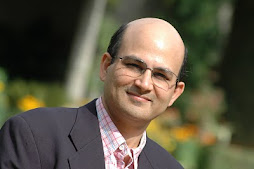
The Tata Group Innovation Forum and associated activities have been in place for about a decade now. Here is what we can learn from them....
Saturday, June 6, 2015
Friday, May 22, 2015
A Tribute to Vidyanand Jha and Dheeraj Sanghi as they turn 50
This post is dedicated to two of my friends who just turned
50.
A Creative Persona
He was one of the first friends I made as a doctoral student
at IIM Ahmedabad (IIMA) in 1991. Poet, film buff, supporter of the underdog,
teacher of creativity, voracious reader, questioner of authority, former left
activist, jazz enthusiast Vidyanand Jha celebrated his 50th birthday
recently.
As doctoral students at IIMA, we had to do many of the first
year classes along with the MBA students. So, we were part of one of the
sections of the MBA class, in the spacious amphitheatre-like classrooms for
which IIMA is famous. We were seated towards the back, on the right hand side,
with one MBA student between us. But as
far as I can recall, we were already friendly even before we were
serendipitously seated so close to each other.
Several things stood out about Jha – his looks, his photo-chromatic
glasses which helped him hide his eyes or even let him sleep while classes were
in progress, the diversity of his experience compared to the typical MBA
student! Many of our classmates had probably never heard of the CPI-ML, let
alone been a member. I recall one occasion on which a professor asked how many
students had a rural address, and Jha was the only one who put up his hand. Jha
used to hang out with the senior, scholarly yet rebellious doctoral students
who held forth on the philosophy of management thought and life.
While at IIMA, Jha and I used to attend every seminar we
could. So, we got exposure to a wide variety of subjects and speakers. But,
neither he nor I became great researchers in the traditional academic sense. I
think we just enjoyed the exposure and the discussions.
As evidenced by his Facebook posts today, Jha is a member of
multiple worlds. One is the world of Maithili literature. Jha is an
accomplished poet himself, and has been published by the Sahitya Akademi. He
has also translated books into Hindi. I tried to persuade him to translate my
book From Jugaad to Systematic Innovation into Hindi but didn’t succeed in
doing so. Maybe he would have done it if it were fiction. I often ask myself
how strong is the dividing line between fiction and non-fiction – after all,
even non-fiction is based on the lens through which you see things. But, may be
Jha doesn’t see it that way.
Jha has been a member of the faculty at IIM Calcutta since
he finished FPM at IIMA. Kolkata has always been the gateway to the east, and
his location has helped him remain in close contact with his home. He has also
become a fluent speaker of Bengali. Kolkata has a good number of literary and
cultural events, and it’s a clear sign of Jha’s cultural interests that he has
managed to attend these in spite of the fact that IIMC is miles away from the
centre of town. That’s quite unlike many contemporary management academics who
lead a much more sequestered life.
Over the time I have known him, Jha has been a compulsive
giver, particularly of macabre films. But the fun part is that he doesn’t see
them as violent or offensive. Maybe that just comes from being a writer and a
film buff.
Many years ago, in an article in EPW, Ramachandra Guha
bemoaned the loss of the bilingual intellectual. Guha spoke too soon – Jha can
be an intellectual in Maithili, Hindi and Bengali in addition to English! But
if I have one regret, it’s that Jha (like many other Indian scholars) has been
more in the Indian oral tradition than a great writer as far as management is
concerned. From talking to him, and seeing the feedback of his students, I can
see that he has lots of interesting insights into management and organizations,
but few of these have found their way into print.
Reflecting his left leanings, Jha has always been quick to
take the side of the underdog. I can remember one warm afternoon many summers
ago when he and another friend of ours derided the IT industry for creating
cybercoolies.
A Change-Maker
Another friend who turned 50 recently, is an equally weighty
academic. Dheeraj Sanghi was technically one batch junior to me at IIT Kanpur,
but we graduated in the same year as he did a 4-year BTech, and I did a 5-year
integrated MSc programme.
I got to know Dheeraj thanks to another friend, Pramath
Sinha. We were building our team for the Cultural Festival and Pramath brought
in Dheeraj to manage our finances. Dheeraj was active in student politics , and
so was I, but I got to know him well only after he became a member of our
Festival team (he did a great job!).
After a PhD at Maryland, Dheeraj returned to our alma mater
and has been a faculty member there ever since. Like Jha, Dheeraj is also a
straight talker, and not one given to excessive diplomacy and tact. But he has
been fiercely loyal to IITK and has put tremendous effort into sustaining its
best traditions. As Dean of Academic Affairs over the last few years, he was an
enthusiastic innovator, with all his efforts directed towards helping IITK achieve
the best academic standards.
Dheeraj has never been afraid to experiment. He took a
couple of years off to head the LN Mittal Institute of Technology in Jaipur,
and though I couldn’t visit him during that stint, from what he told me it is
clear he managed to try out a lot of new things there as well.
Dheeraj just moved to IIIT Delhi for a couple of years. IIIT
Delhi already has a creative leader at its helm. But Pankaj Jalote should watch
out, Dheeraj will soon be ready to unleash his ideas there as well.
Dheeraj’s commitment to engineering education has been
evident from his blog. He has waded into controversial issues like the
two-stage JEE process with gusto and has always managed to provide very logical
and thought-provoking analyses.
One of Dheeraj’s other passions has been the Indian
Railways. He travels long distances (by train, of course) to attend conferences
of other rail buffs like himself. He explores the myriad options available on
the IRCTC ticketing website, sometimes landing up in all sorts of trouble as a
result, and he then has to valiantly try to recover his money using various
clauses of the Railway manual.
I am surprised that Dheeraj hasn’t figured in the recent
round of IIT director appointments. Maybe he is too outspoken. But, time is on
his side, and I hope the country will take advantage of his energy and vast
reservoir of ideas to build one of our institutions.
It’s been my privilege to know Jha and Dheeraj. As they
cross 50, here’s wishing them many more years of creative endeavours.
Monday, May 18, 2015
Lessons from Jagdish Sheth on what it takes to be a management guru
Jagdish Sheth's autobiography - The Accidental Scholar - gives useful insights into what it takes to become a management guru. More here
Sunday, April 26, 2015
Creating a Distinctive Identity for Indian Management Education
How should the Indian B-school and MBA program of 2015 be
distinctive? And what can our business education offer to the rest of the
world? These are two questions that flashed across my mind as I attended MBA
Universe’s Asian Management Conclave (AMC) at Singapore recently.
For my answers to these questions, read this.
Sunday, March 29, 2015
VidyaGyan: Allowing Indian Talent to Flower and Bloom
The Shiv Nadar Foundation's VidyaGyan schools bring the best school education to bright students who can't afford it.
My latest post on VidyaGyan is available here
Friday, March 20, 2015
Making Inclusive Innovation Work
[This week's post is a continuation from last week's post - insights from the Inclusive Innovation conference held at Rashtrapati Bhavan.]
Funding Innovation
Funding of innovation is always a challenge, and one that
different countries solve in different ways.
Gilles G. Patry, President & CEO spoke about how the
Canada Foundation for Innovation has invested over a billion dollars in state-of-the-art
facilities at universities across Canada to help them do world-class research. The
Foundation funds upto 40% of the project cost and focuses on partnerships. He
suggested that the model is largely successful. The evidence? - Canada punches above its weight on research
and accounts for 5% of impactful research papers [sorry, I can’t recall exactly
how this was measured or over which period.]
For me, one of the big attractions of the Round Table was
the participation of Nobel Laureate and Grameen Bank founder Mohammed Yunus.
For someone who has brought revolutionary ideas like microfinance to the world,
he was surprisingly skeptical about the availability of finance. According to Yunus, the sector needing the
largest innovations is the finance sector! Professor Yunus drew our attention
to what he considered the biggest achievement of Grameen Bank - in savings and
not in lending! He estimated that the Grameen Bank had contributed to more than
$2B savings so far.
A German participant pointed out that money is available for
impact investment but not enough social enterprises are available to absorb
this investment. But, other participants were skeptical of Impact investing,
citing a conflict between the social mission of the enterprise and the
investor’s desired outcomes
Anil Gupta said the ecosystem should support both managed
innovation and spontaneous innovation. He stressed the need for both a sanctuary
model that has chaos inside and order
outside and an incubator model that has
chaos outside and order inside.
Making Social Innovation Work
Several useful ideas emerged on this theme:
One participant made an interesting observation – most people
today recognize 1000 corporate logos but fewer than 10 plant species. Parag
Anand of the School of Planning & Architecture (SPA) at Delhi came up with
at least one solution to this problem – the SPA organizes tours for student
immersion as user experience is critical to social innovation.
Iyer from the Mumbai-based Indian Foundation for Development
(IFD) spoke about the need for tinkering rooms/workshops in schools as also
innovation exchange programmes. The IFD has started 185 balagurukuls that host
12500 children, and there is a need to expose them to creativity and innovation.
Anil Gupta advocated the Indian concept of samavedana –
making others’ pain your own, or empathetic innovation.
Mohammed Yunus suggested targeting waste. He said that at
least one out of every 6 pairs of shoes bought by customers is not worn. Can’t
these be re-channelised to the poor? Can’t cloth rejected by textile mills also
be used?
Some participants wondered how existing innovations could be
spread or diffused better. Reaching the market is often difficult. Anil Gupta
gave an interesting example of four machine tool start-ups in
Ghazaiabad/Faridabad that started a common marketing company so that together they
would have a broad enough catalogue and a large enough volume of products to
justify marketing expenditures.
Grameen Bank uses the joint venture route to solve new
problems and reach users. For example, it has a joint venture with BASF for
treated mosquito nets, and uses the Grameen Bank channel including self-help
groups to reach users. The scientist from LBNL advocated coming up with innovations
that the corporate sector will embrace.
Corporate Sector vs. Social Sector
In fact, the liveliest debates were about the role of the
corporate sector and the social sector. Lines
were clearly drawn with some people like this scientist clearly preferring
market-based solutions and others clearly distrusting the private sector to do
anything beyond enriching itself. The word “trust” figured in many of these
discussions.
Solomon Darwin of the University of California at Berkeley
pointed out that while open innovation is a 2-way street involving ideas
flowing both outside in and inside out, corporations have tended to focus only
on the former. He pronounced that the world of high margins is over though I
wonder how this can be completely true when Apple is sitting on hundreds of
billions of dollars amassed through huge margins.
One of the most engaged participants in the Round Table was Jin
Hyo Joseph Yun of South Korea. One could almost see his mind working as he
tried to relate what he had seen in the exhibition to the discussion in the
conference room! He tried to build a model on the fly – volunteers are needed to
connect technology to society/market but virtuous big business is needed to make
it commercially successful.
Stuart Hart cited Polanyi to make a point that was in one of
his articles - production has got disembedded from the social world. People
have come to distrust the business process. There is a need to re-embed
economic activity in society, that is to build business models that create
mutual value.
Mukesh Puri, Secretary Higher & Technical Education, Government
of Gujarat believed that successful innovations have to be owned by the people
. The perceived benefits need to be clear. He cited Pravesh Utsav, a
celebration held at the time of girls joining school in Class 1 All political
figures participate. He said that the drop-out rate has declined as a result.
Conclusion
It is ironic that innovation which is inherently an
integrative activity is today impeded by silos. These silos are reinforced by
different philosophies and worldviews. We may have to rely on other forces at
work to lower these walls. Take the new requirement of compulsory CSR activity
by Indian companies – this is forcing companies to work more closely with NGOs
and other social organizations. Hopefully, this will create an environment in
which companies and NGOs recognize each others’ worth, and lead to
collaborative and inclusive innovation in the future.
[This blog has been written based on notes taken by the
author. These have not been re-checked with the speakers. Views expressed are
those of the individuals and do not necessarily represent the institutions they
work for.]
Saturday, March 14, 2015
Revisiting Inclusive Innovation: Notes from a Recent Roundtable
The practice of inviting outstanding grassroot innovators to
the majestic environs of Rashtrapati Bhavan, the home of India’s head of state,
was started by President APJ Abdul Kalam when he was president. It’s a tribute
to the rootedness of our national leaders and the persistence of Drs. Anil
Gupta and RA Mashelkar that the practice has not only continued but been
reinforced over time. This year, the event evolved into a week-long “Festival
of Innovations” with award ceremonies, workshops and roundtables.
Under the Tent…
The centre of the festival was a huge temporary structure
pitched on the Rashtrapati Bhavan Football Grounds that had exhibits and
demonstrations of all the award-winning innovations. The innovators must have
been encouraged by the large crowds in the hall, even though the main
destination of the crowds was the famed Mughal Gardens, thrown open to the
public at this time every year.
The innovations themselves were not very different from
earlier grassroot innovations that I have seen, at least in terms of the
categories they represented. The most prominent was mechanical devices to do
tasks that would otherwise be done manually. Many of these were focused on farm
operations but some were on health and sanitation. Devices to help people with
disabilities, and improved agricultural varieties were other important
categories.
Some of the impressive innovations included a modified
walker that enables climbing stairs, interlocking bricks, and wearing a helmet
as an ignition switch for a motorcycle.
The centre of the hall had banners with quotations on
innovation, largely from Anil Gupta and Mashelkar. Truth be said though, there
weren’t many people reading these banners, and I wonder how many people would
have appreciated the nuances of the quotes even if they had read them!
The innovators themselves were present, and many of them
were peppered with questions by enthusiastic visitors. I imagine this must have
been motivating for them, though by the end of the day they must have been
exhausted!
But, if the purpose of the event was to recognize and
encourage innovators from all corners of our country, and to underline the
democratic idiom of innovation (“Anyone can innovate”), I am sure this event
served its purpose.
…. And Inside the Conference Room
Inside the newly constructed Rashtrapati Bhavan Cultural
Centre with its high ceilings and ornate decorations (including larger than
life size portraits of all India’s presidents till date), innovation experts
from all over the world conferred about the future of inclusive innovation.
What are the problems to solve?
If you read our book 8 Steps to Innovation, you might
remember that we advocated creating a challenge book of the most pressing
problems that are literally crying for innovation. One piece of good news is
that the Lawrence Berkeley National Laboratory (LBNL) Institute for GloballyTransformative Technologies has identified the fifty most important global
problems to solve with technology. These include low-cost desalination to make
drinking water available at a reasonable cost; a DNA-based diagnostic for
accurate detection of tuberculosis; an integrated “clinic-in-a-box” for
maternal and child care; low-cost homes for the urban poor; and a very timely point-of-use
DNA-based rape kit to enable timely collection of evidence against perpetrators
of rape.
Of course, there are solutions searching for problems as well.
The co-founder of the notion of the fortune at the bottom of the pyramid (BoP),
Stuart Hart drew attention to the wealth of “shelf technologies” in
universities. At Cornell alone he reported that the university found about
4,000 technologies / patents that had not been exploited.
Anshu Gupta, founder of Goonj had a different take on
problems. He argued that there are many “non-issues” that need to be made
issues. Clothing is important, as important as food and shelter. Why can’t
clothing also be a parallel currency? Earlier clothing was only part of
disaster relief and charity. Why can’t cloth be given for work?
Anshu pointed out the importance of clothing by reminding
the audience that more people die due to cold in winter than due to other
calamities.
Drawing attention to another “non-issue” that needs to
become an issue, he said that 88% of women don’t have access to sanitary
napkins.
How to solve the problems?
Hart advocated an intermingling of what he called “exponential
technologies” with traditional ones to address the problems of people at the
BoP.
But, going back to the exhibition for a moment, it’s
interesting to reflect that there were hardly any “modern” technologies like
electronics or computers on display in any of the exhibits. The only such
device in use was the mobile phone, and even this was in very small numbers.
An earnest NRI from a US lab had a different take on this.
While he felt that India should continue to build world class R&D
institutions, he thought that solutions may be available more quickly if the
government were to subsidize private sector R&D or, more radically,
“reverse outsource” critical problems to western research centres. What he was
suggesting here is that the Indian government commission (say) a Pfizer or a
Merck to come up with a new cure for tuberculosis and make it worth their while
by underwriting all the research expenses. But I really wonder whether that’s a
business model they would be interested in; what could work though is for the
government to give a research contract to one or more outstanding academic or
research laboratories abroad.
Brock from the UNICEF Innovation Centre underlined the
importance of design with the user rather than for the user. He emphasized that
design should be for scale, and that an organization liked UNICEF should
embrace open standards (not open source) since a public organization should
embrace public goods.
But, he admitted that there was a need to change their
mindset from seeing the private sector only as suppliers to working with
grassroot innovators as partners.
I spoke about the importance of government procurement, and
policies regarding standards in making social innovation work. Rigid standards
designed with existing technologies and suppliers in mind can keep out
important innovations. Pre-qualification clauses can act as barriers to entry.
The government sometimes encourages imitation without respecting intellectual
property. And tender procedures prevent government from procuring things that
might have been developed specifically for the government. Instead, the
government should play a more positive and proactive role in supporting
inclusive innovation.
How do you make Inclusive Innovation work?
To conclude this piece and share the key takeaways, please
visit this space next week….
[This blog has been written based on notes taken by the
author. These have not been re-checked with the speakers. Views expressed are
those of the individuals and do not necessarily represent the institutions they
work for.]
Subscribe to:
Posts (Atom)